October 8, 2026
The question is no longer whether organizations are investing in artificial intelligence. They are and in a big way!
The harder question is:
Where is the return?
According to IBM's 2025 CEO Study, only 25% of AI initiatives have delivered their expected ROI, and just 16% have scaled across the enterprise. At the same time, 64% of CEOs say the fear of falling behind is causing their organizations to invest in technologies before they fully understand the value those investments will bring.
The problem isn't necessarily that AI doesn't create value.
The problem is that buying AI is not the same as creating value with AI.
It's easy to see how organizations get here.
A team discovers a powerful new AI capability. Someone identifies a promising use case. A proof of concept is built. The results look impressive.
Then another team does the same thing.
And another.
Before long, an organization may have dozens of AI experiments, copilots and point solutions—but very few that materially change how the business operates.
As one technology executive described it, companies have too often approached AI with the mindset of “Build it and they will come.”
The result can be impressive technology without an equally impressive business return.
Imagine an organization uses AI to make a particular employee task 30% faster.
That's a real improvement.But what happens if that task represents only a small part of a larger process?
Suppose an AI system can identify a potential supply chain problem in seconds. If an employee still has to manually investigate the issue, find the relevant supplier information, determine who owns the problem, send an email and create a task in another system, much of the potential value remains unrealized.
The organization improved one step.
It didn't necessarily improve the process.
This distinction matters enormously.
The real opportunity isn't simply to make individual tasks faster.
It's to rethink how the entire workflow operates.
Forbes Research found that executives report significant improvements from AI in areas such as decision-making, operational efficiency and product and service quality. Yet fewer than 1% of surveyed executives reported significant ROI of 20% or more, while 53% reported limited ROI of only 1–5%.
There is an interesting contradiction here:
AI appears to be helping. But the financial impact isn't always showing up.
One reason is measurement.
Thirty-nine percent of executives surveyed by Forbes said that measuring ROI and business impact is one of their primary challenges with AI. Some executives cited benefits that are indirect, long-term or difficult to express in dollars.
But measurement isn't the only problem.
Sometimes the business process itself hasn't changed enough to capture the value AI could create.
Consider the difference between these two approaches.
Approach 1:
Use AI to predict which suppliers might create a problem.
Approach 2:
Use AI to identify supplier risk, understand its potential impact, recommend an alternative, notify the responsible manager and initiate the appropriate procurement workflow.
The first produces an insight. The second produces an outcome.
That's where AI ROI becomes much more tangible.
The value of AI isn't necessarily in generating another prediction, summary or recommendation.
It's in what the organization can do with that intelligence.
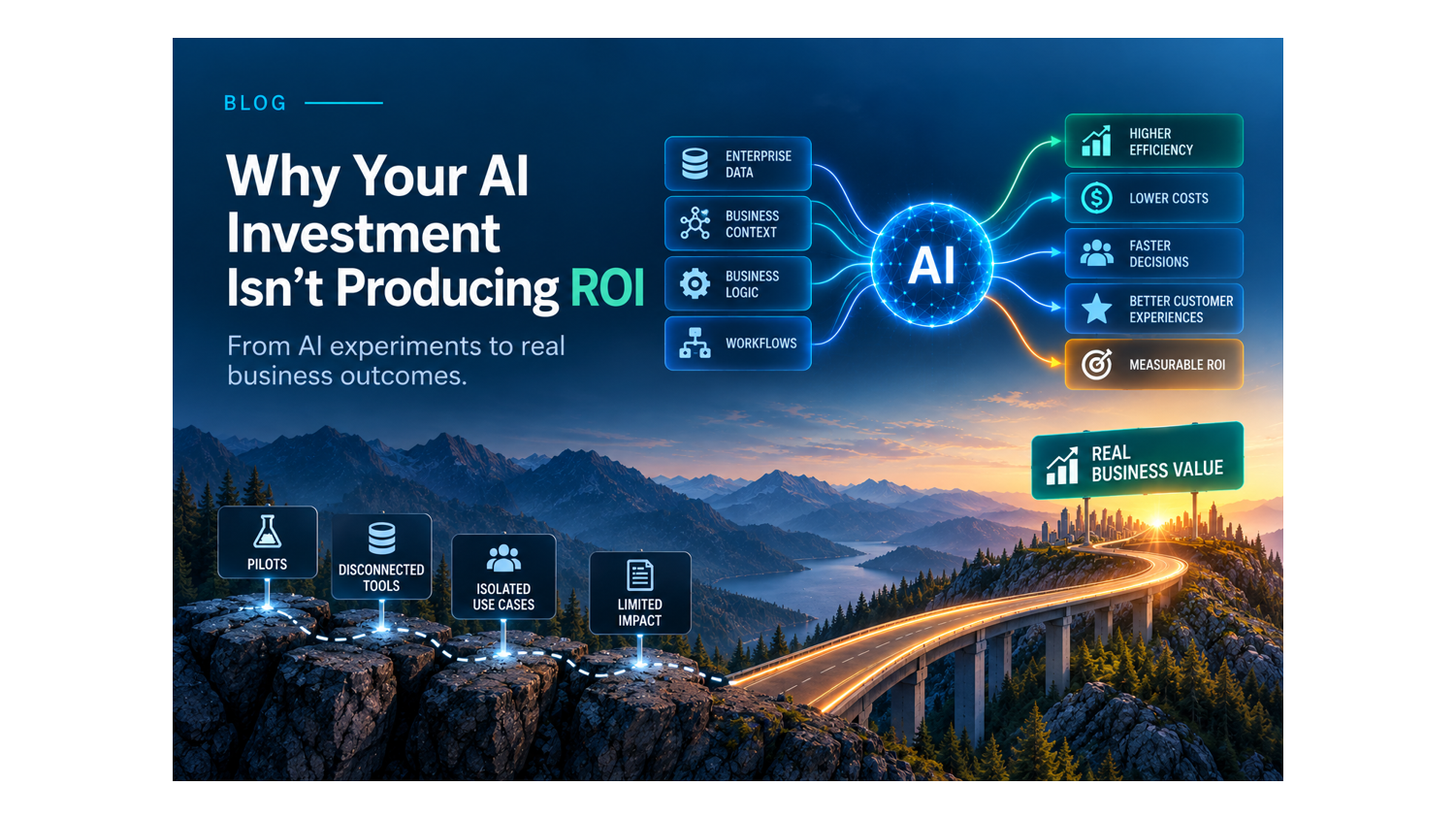
For AI to produce measurable business value, several pieces need to work together:
Data
The organization needs access to the right information.
Context
AI needs to understand relationships, history and business meaning.
AI
Models and agents need to reason over that information.
Business Logic
The organization needs rules governing decisions and actions.
Workflow
Those decisions need to trigger something.
People
Employees need to know when and how to participate.
Measurement
The organization needs to know whether the change actually produced value.
If these pieces remain disconnected, AI can become another layer of technology that employees have to work around.
When they are connected, AI can become part of the way the business operates.
One of the most common mistakes organizations make is starting with the technology.
What can we do with this new AI model?
That's an interesting question.
But it's not necessarily a good business question. A better starting point is:
Where are we losing time, money or opportunities?
Then ask:
Could AI change the way this process works?
This changes the conversation from AI experimentation to business transformation.
Instead of measuring how many people are using an AI tool, you can measure things that matter to the business:
Now there is something meaningful to measure.
This is why the architecture surrounding AI matters.
If AI lives in one application, business data lives somewhere else, workflows live in another system and employees have to move between them, the organization has created another integration problem.
The alternative is to build AI into the business application itself.
Imagine an application where the AI can access trusted enterprise data, understand the relationships between that data, apply business rules, generate an insight and initiate the workflow required to act on it.
Now AI isn't simply answering questions. It is participating in the process that creates business value.
The organizations that get the most from AI won't necessarily be the ones that deploy the most models or launch the most pilots. They will be the ones that can consistently answer three questions:
What business problem are we solving?
How will AI change the process?
How will we measure the resulting value?
IBM's research points in this direction as well. Its 2025 study found that 65% of surveyed CEOs said their organizations were prioritizing AI use cases based on ROI, while 68% said they had clear metrics for measuring innovation ROI.
The shift is from AI adoption to AI value realization. And that requires more than a model.
This is one of the ideas behind Process Tempo Jupiter.
Jupiter brings data, graph analytics, AI, dashboards and workflow together in a single application development environment.
The goal isn't simply to give organizations another way to experiment with AI.
It's to help them build applications where data, context, AI and workflow work together.
Because the ultimate measure of AI isn't how impressive the model is. It's what happens after the model produces its answer.
Does someone have to figure out what to do next? Or does the application help turn that intelligence into action?
That's where the difference between an AI experiment and an AI-powered business process begins.
AI is not failing to create value.
In many organizations, value is being created—but it is trapped inside disconnected experiments, isolated tasks and point solutions.
The next phase of enterprise AI is about connecting those capabilities to the processes that actually drive the business.
The question isn't:
“How much did we spend on AI?”
And it isn't even:
“What can AI do?”
The more important question is:
“What business outcome can we create by putting AI directly into the way our business works?”
That's where AI investment becomes AI value.



Build enterprise-ready applications without writing code.
